
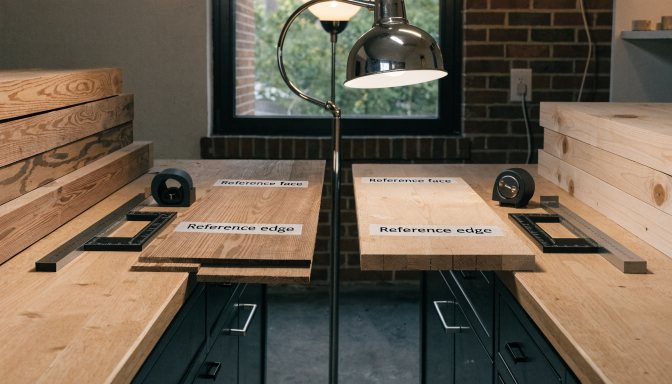
Accuracy problems in a home shop are often blamed on limited space or cheaper tools, but many of them come from inconsistent habits. Good results do not require a luxury workshop. They require a workflow that keeps references consistent, repeated parts matching, and assemblies checked before mistakes are locked in.
Quick answer: Common home-shop accuracy mistakes include changing reference edges, using unclear measuring marks, skipping stop blocks for repeated parts, trusting a bad setup, and checking for square only at the end. Small-shop accuracy improves most when the process becomes more consistent.
Why accuracy slips in home shops
- Temporary work surfaces shift more than expected
- Portable tools are used without guides or support
- Repeated parts are measured one at a time
- Layout systems change halfway through the build
The fixes that matter most
Stabilize the work
A shaky bench or loose board can ruin even a good layout. Workholding is part of accuracy, not just convenience.
Use stops and guides
Stop blocks, straightedges, and simple jigs reduce the number of variables the builder has to manage at once.
Check square as you go
Accuracy is easier to maintain than recover. Frequent checks are faster than major fixes later.
Accuracy habit checklist
| Habit | Benefit |
|---|---|
| Reference from one face and one edge | Keeps related parts aligned |
| Use a sample part for repeats | Improves matching dimensions |
| Support long or awkward stock | Reduces drift during cutting |
| Dry fit key assemblies | Exposes error before glue and screws |
Bottom line
Home-shop accuracy does not come from perfect conditions. It comes from repeatable habits that remove unnecessary variation from each step of the build.