
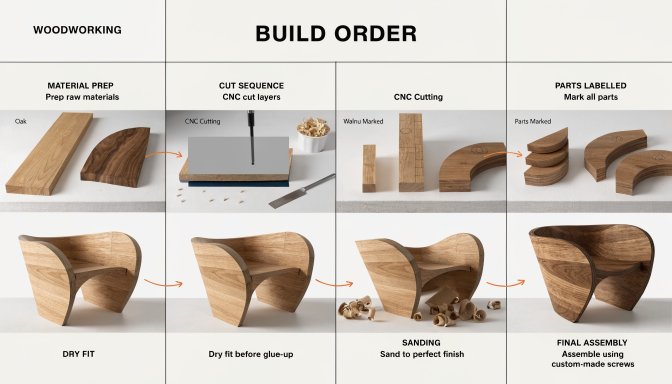
Build order matters because woodworking gets harder every time a later step blocks an earlier one. A weak sequence creates extra handling, awkward clamping, missed prep work, and assemblies that are more difficult than they needed to be. Good build order makes the whole project feel calmer.
Quick answer: A solid woodworking build order usually follows this pattern: understand the plan, prep materials, cut critical matching parts first, test fit major sections, do edge cleanup and prep while access is easy, then assemble in stages instead of all at once.
Why build order goes wrong
Cutting everything at once
This feels efficient, but it often multiplies mistakes and removes flexibility too early.
Skipping prep steps until after assembly
Some sanding, drilling, or edge work is much easier before parts are locked together.
Assembling too large a section too soon
Big assemblies are harder to adjust, harder to clamp, and harder to check for square.
A practical build-order framework
| Stage | Main goal |
|---|---|
| Plan review | Understand all parts, dependencies, and dimensions. |
| Material prep | Sort usable stock and stage the right boards or panels. |
| Critical part cutting | Cut matching or controlling parts carefully first. |
| Dry fit | Check how the parts actually meet in real space. |
| Pre-assembly prep | Handle sanding, drilling, and cleanup while access is easy. |
| Staged assembly | Build in sections and confirm alignment at each step. |
Bottom line
A better build order reduces both mistakes and stress. When the sequence makes sense, the project asks for fewer corrections later and becomes much easier to finish cleanly.