
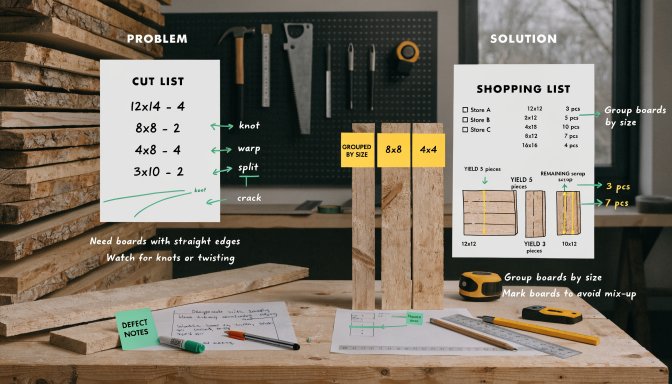
Buying lumber from a cut list is easier when the list has already been turned into a material strategy. A cut list tells you what parts you need. It does not automatically tell you the smartest board sizes to buy, how defects will affect yield, or how much waste margin makes sense for the project.
Quick answer: To buy lumber from a cut list, group parts by thickness and length needs, choose board sizes that fit the most important pieces first, account for waste and defects, and shop with usable yield in mind instead of raw board footage alone.
How to convert the cut list into a buying plan
Group similar parts together
Look for parts that can come from the same board widths, thicknesses, or sheet sizes. This makes the buying list more efficient and easier to compare at the store.
Prioritize long and critical parts
Those parts usually have fewer replacement options. Buy for them first, then fit smaller secondary parts into the remaining yield.
Expect some real-world loss
Boards are rarely perfect. Knots, checks, twist, and rough ends reduce the usable area. Good buying plans leave room for that.
Buying-plan table
| Buying decision | Smarter approach |
|---|---|
| Board length | Choose lengths that suit the longest key parts first |
| Board width | Buy widths that reduce ripping waste when possible |
| Waste margin | Add realistic allowance for defects and corrections |
| Premium stock use | Reserve higher-quality boards for visible or critical parts |
Bottom line
A cut list becomes a better shopping tool when you read it through the lens of yield and usability. Buy for the parts that matter most, and the rest of the project gets easier to fit around them.