
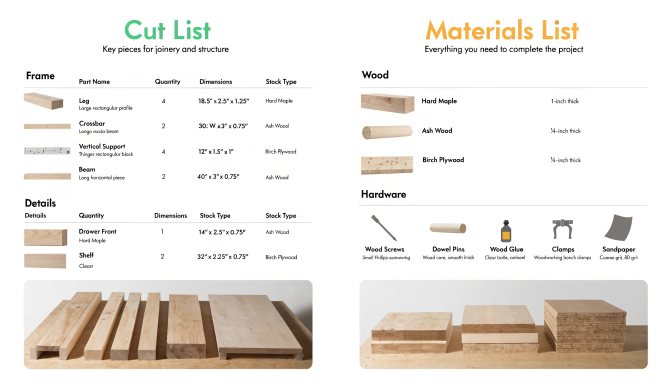
Many beginners treat the cut list and the materials list like the same thing, but they solve different problems. A cut list tells you what finished parts the project requires. A materials list tells you what raw stock, hardware, and supplies you need to make those parts and complete the build.
Quick answer: In woodworking, a cut list describes the finished project parts, while a materials list describes what you need to buy. The cut list helps you cut accurately. The materials list helps you shop and stage the build more efficiently.
What a cut list does
A cut list turns the project into individual parts. It includes names, quantities, finished dimensions, material type, and notes that connect the part back to the drawing or build sequence.
What a materials list does
A materials list groups the raw inputs for the project. That includes boards, plywood, hardware, fasteners, glue, and finish supplies. It helps you prepare the full build before the first cut happens.
Quick comparison table
| List type | Main purpose | Typical contents |
|---|---|---|
| Cut list | Plan the parts | Part names, quantity, finished sizes, material, notes |
| Materials list | Plan the purchase | Boards, sheet goods, hardware, fasteners, glue, finish supplies |
Why the difference matters
If you use only a cut list, you may still forget hardware or buy the wrong raw stock. If you use only a materials list, you may still feel lost once it is time to translate that stock into actual parts. Strong projects usually have both lists working together.
Bottom line
The cut list helps you build. The materials list helps you prepare. Once you use each one for the job it is meant to do, projects become easier to buy for, easier to stage, and easier to cut cleanly.