
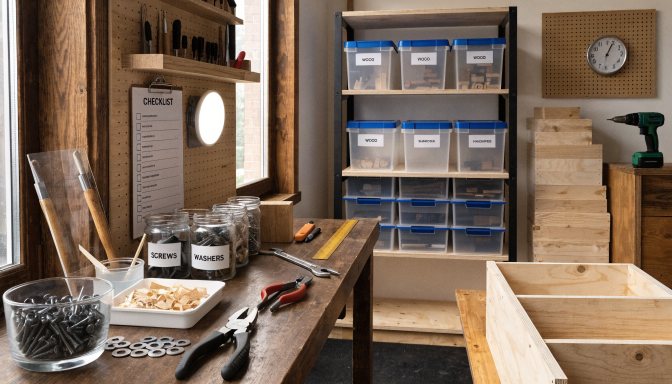
Frustration in woodworking usually comes from avoidable uncertainty. Missing dimensions, mixed-up parts, unrealistic project choice, and poor sequencing create pressure that builds with every step. The solution is rarely to push harder. It is to make the process more understandable and more controlled.
Quick answer: To reduce frustration in woodworking, use clearer plans, choose more realistic projects, label parts as you cut them, stage materials in order, and add small checkpoints before assembly. Better process usually lowers frustration faster than better tools.
Common causes of woodworking frustration
- Trying to improvise from incomplete plans
- Starting projects that do not fit the shop or schedule
- Losing track of parts during cutting and assembly
- Not checking fit until it is too late to correct easily
Practical ways to lower frustration
| Frustration source | Better system |
|---|---|
| Confusing plans | Choose plans with clear steps and lists |
| Messy workflow | Stage current parts only |
| Assembly surprises | Dry-fit important joints first |
| Project overwhelm | Scale down to a more realistic build |
Why mindset still matters
A calm, problem-solving mindset helps, but it works best when paired with a better system. Staying patient is easier when the plan is clear and the next step is visible.
Bottom line
Reducing frustration in woodworking is mostly about reducing preventable uncertainty. Clearer plans and cleaner systems make the work feel much more manageable.