
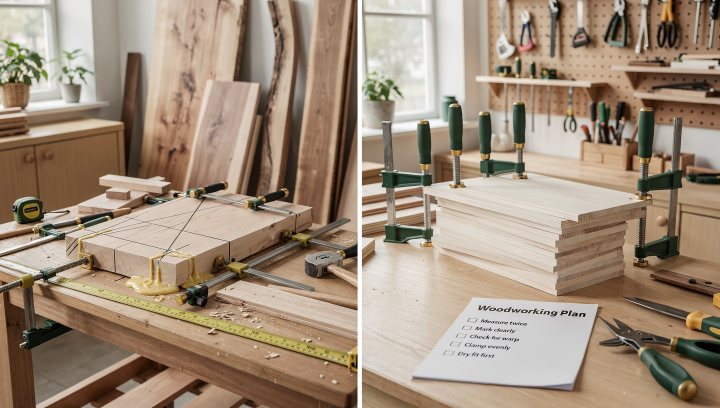
Most beginner woodworking mistakes do not come from lack of effort. They come from starting too fast, skipping small checks, and assuming the project will sort itself out as you go. That usually leads to wasted lumber, extra trips to the store, and a build that feels harder than it should have been.
Quick answer: The most common beginner woodworking mistakes are poor planning, inaccurate measuring, bad material selection, rushing the first cuts, and assembling parts before checking for square. Most of these mistakes can be prevented with a simple pre-build workflow.
The five mistakes that show up most often
1. Starting before understanding the plan
Beginners often read just enough of a plan to get moving. That leads to missing parts, wrong material thickness, and bad build order later.
2. Measuring loosely
Using rough marks, switching reference edges, or trusting memory instead of writing things down creates small errors that stack up fast.
3. Cutting all the wood at once
Batch cutting without verifying one sample part is a fast way to produce several wrong pieces instead of one fixable mistake.
4. Ignoring board quality
Twisted, cupped, or damaged boards make even good planning harder. A bad board can turn a simple project into an alignment fight.
5. Rushing assembly
Projects go crooked when parts are forced together before checking fit, clamp pressure, and square.
A better beginner workflow
| Before you start | Why it matters |
|---|---|
| Read the full plan | Prevents surprises in materials, cut order, and hardware. |
| Check dimensions and thickness | Confirms the design matches what you are actually buying. |
| Make one test cut | Catches mistakes before they multiply. |
| Dry fit first | Shows alignment problems before glue or screws lock them in. |
Bottom line
Beginner mistakes are normal, but most are predictable. The easiest way to improve faster is not buying more tools. It is slowing down enough to build a simple, repeatable process before the first cut.