
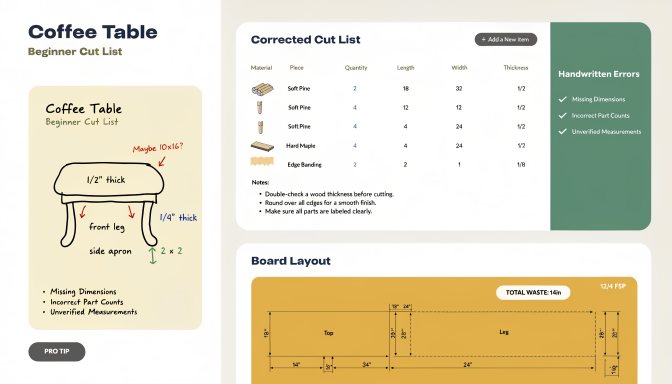
Cut lists are supposed to simplify a build, but for beginners they can do the opposite when they are incomplete, unclear, or treated like a shopping note instead of a planning tool. A weak cut list creates problems before the first board is even on the saw.
Quick answer: The most common beginner cut-list errors are missing part labels, mixing finished and rough sizes, ignoring material thickness, leaving out quantities, and cutting from the list without checking how the parts relate to the full project. A strong cut list should reduce thinking during the build, not create more of it.
Where beginners go wrong
They confuse the cut list with the materials list
A materials list tells you what to buy. A cut list tells you what each project part needs to become. Mixing the two creates confusion fast.
They skip the quantity column
One missing number can mean missing parts, doubled parts, or bad lumber estimates later.
They do not show thickness clearly
Length and width are not enough if the design depends on matching stock thickness or sheet-good dimensions.
They leave parts unlabeled
If the list says “rail” or “panel” without location, orientation, or note, assembly gets harder than it needs to be.
What a useful cut list should include
| Column | Why it matters |
|---|---|
| Part name | Keeps each piece tied to the plan. |
| Quantity | Prevents missing or duplicated parts. |
| Thickness, width, length | Clarifies the finished size target. |
| Material type | Separates hardwood, plywood, and construction lumber parts. |
| Notes | Flags joinery, grain direction, or matching sets. |
Bottom line
A cut list should make your build calmer, not more confusing. When the list is clear, labeled, and tied back to the full plan, it becomes one of the best tools for avoiding waste and rework.