
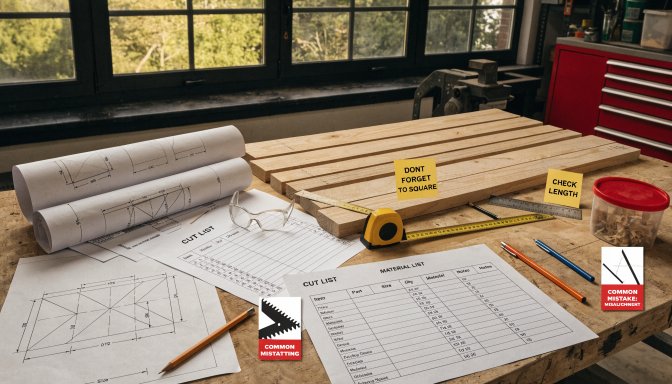
A lot of wood project frustration gets blamed on cutting or assembly, but the trouble often starts earlier. The first major mistake is thinking the build begins at the saw. In reality, the build begins with project selection, material planning, part tracking, and a clear order of operations.
Quick answer: The biggest wood project mistakes before the first cut are choosing the wrong project for your tools, failing to read the plan fully, not building a cut list, ignoring material thickness, and starting without a clear build order. Those mistakes usually create problems that are harder to fix later.
What to check before any cutting starts
- Does the project match your tool setup and workspace?
- Do you understand every major part and joint in the plan?
- Is there a finished cut list and materials list?
- Have you checked the actual sizes of the lumber or sheet goods?
- Do you know what needs to be cut first and what should wait?
Why these early mistakes hurt so much
Early planning mistakes do not stay isolated. If the materials are wrong, the cut list becomes wrong. If the cut list is wrong, the build order gets harder. If the build order is weak, assembly becomes improvisation. That is how small oversights become expensive rework.
A safer pre-build workflow
| Step | Purpose |
|---|---|
| Review the full drawing set | Find hidden dependencies and unclear details. |
| Translate plan parts into a cut list | Turn the design into actual pieces you will build. |
| Lay out the material strategy | See how boards and panels will be used before buying or cutting. |
| Sequence the build | Keep later steps from blocking earlier ones. |
Bottom line
If you want fewer surprises, treat the first cut as a checkpoint, not the starting line. Better results usually begin with better preparation.