
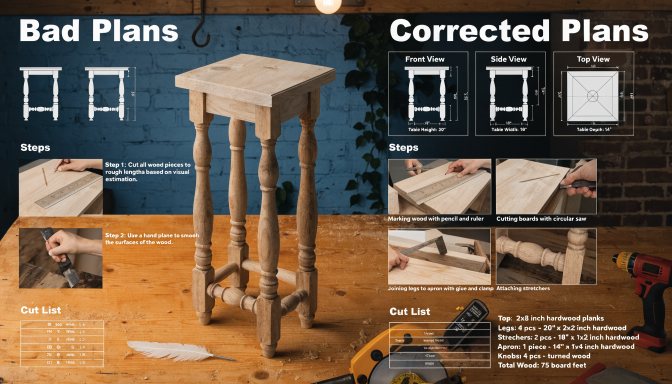
Even a careful builder can struggle with a bad plan. Weak plans do not just slow the project down. They force guesswork into parts of the build that should be simple, like material selection, cut sequencing, joinery placement, or assembly order.
Quick answer: Woodworking mistakes with bad plans usually come from missing dimensions, unclear part labels, weak cut lists, vague step order, and no explanation of how parts relate to each other. Good plans reduce guesswork. Bad plans shift the risk onto the builder.
Signs a plan may cause trouble
Dimensions are incomplete
If you have to infer too many sizes, the plan is asking you to design while you build.
Part names do not match the drawings
When labels jump around or stay vague, it becomes harder to track the pieces accurately from cut list to assembly.
The build order is not obvious
A good plan makes the sequence feel natural. A weak plan leaves the builder guessing what should happen first.
No material or cut-list support
Without those tools, estimating wood and sequencing parts becomes much harder for beginners.
How to protect yourself from weak plans
| Protection step | Why it helps |
|---|---|
| Rewrite the part list yourself | Forces you to understand the structure before cutting. |
| Sketch the build order | Helps reveal missing or confusing steps. |
| Check actual dimensions against final size goals | Catches hidden thickness and spacing problems. |
| Dry fit in small sections | Reduces the risk of locking in a wrong assumption. |
Bottom line
Bad plans turn straightforward work into guesswork. The best way to reduce that risk is to slow down, translate the plan into your own workflow, and verify the details before you trust them at the saw.