
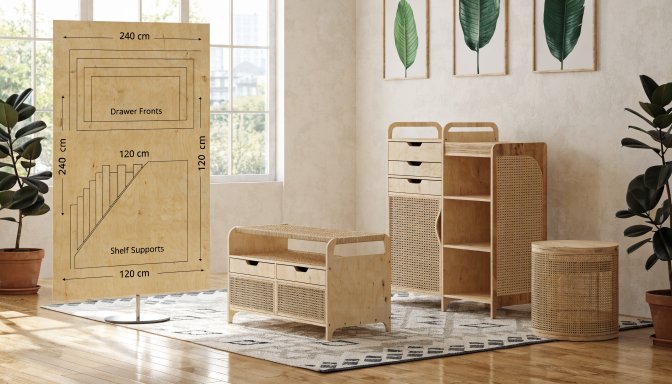
Building more with fewer materials is usually a design decision, not a buying trick. Woodworkers save the most when they choose projects that share dimensions, use repeatable parts, and avoid unnecessary thickness or oversized panels. The goal is not to make projects flimsy. The goal is to make them proportionate and efficient.
Quick answer: To build more with fewer materials, use repeated dimensions, size projects around common stock, plan cut layouts in advance, and favor practical designs over oversized ones. Efficiency improves when the plan fits the material from the start.
Three design habits that stretch materials
Use families of parts
When side panels, shelves, rails, or stretchers repeat across a project, you can cut faster and keep less unusable offcut.
Design around stock size
A shelf depth that matches a common board width often costs less effort than a custom width that creates a leftover strip on every piece.
Choose function over bulk
Many beginner projects get heavier instead of better. Strong enough is often smarter than oversized.
| Material strategy | Why it helps |
|---|---|
| Repeated part sizes | Faster cutting and less measurement error |
| Standard stock widths | Better yield from boards and sheet goods |
| Simple joinery | Less rework and fewer setup-specific mistakes |
| Scalable project size | You can shrink dimensions before buying |
Good project types for material efficiency
- Modular wall shelves
- Stackable storage bins or crates
- Plywood organizers and shop cabinets
- Simple utility furniture with straight parts
Bottom line
If you want to build more with fewer materials, make efficiency part of the design brief. When the project fits the stock well, everything downstream gets easier, cheaper, and more predictable.