
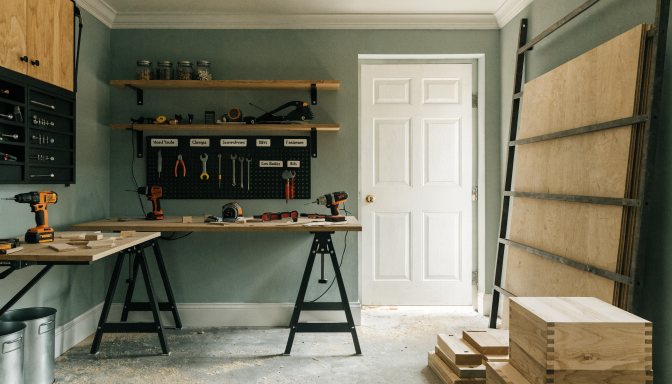
Woodworking in a small garage shop is less about fitting more tools and more about reducing friction. Limited floor space makes every extra move matter. Boards need a temporary home, parts need a sequence, and the build has to match the room. When those pieces are planned, even a one-car setup can feel surprisingly capable.
Quick answer: To work well in a small garage shop, choose manageable projects, keep tool zones simple, stage materials in build order, and protect open floor space for handling long boards or assemblies. Efficiency comes from movement control, not crowding the room with equipment.
Main small-garage problems
- No clear path for breaking down lumber or plywood
- Bench space disappears under tools and hardware
- Projects are selected without considering assembly footprint
- Materials block the same area needed for cutting or glue-up
What helps most
Keep one flexible work surface
A clear bench or mobile cart gives you a place to measure, sort parts, and assemble without constant reshuffling.
Create simple zones
Think in terms of storage, cutting, assembly, and finishing. Even loose zones create better habits than storing everything everywhere.
Build in smaller batches
When space is tight, part families and staged subassemblies are easier to control than one giant spread-out build.
| Garage-shop constraint | Smart response |
|---|---|
| Limited floor area | Use mobile or fold-away surfaces |
| Long board handling | Stage stock vertically until needed |
| Crowded bench | Keep only current tools in the work zone |
| Large assembly footprint | Select smaller or modular projects |
Bottom line
A small garage shop can work very well when the workflow is intentional. The goal is not to mimic a full-size shop. The goal is to make each project fit the space with fewer interruptions and fewer avoidable mistakes.