
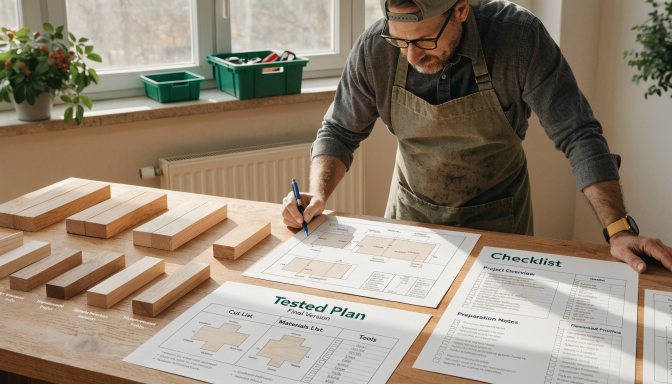
Tested woodworking plans feel different from vague project sketches because they answer practical workshop questions before the build begins. They help you understand what to buy, how to prepare parts, and what order the project should follow. That does not guarantee a perfect build, but it does remove a lot of avoidable uncertainty.
Quick answer: To choose tested woodworking plans, look for complete materials and cut lists, clear step-by-step instructions, consistent dimensions, readable diagrams, and a build sequence that feels realistic for an actual hobby shop. Good plans reduce interpretation work before you ever touch the lumber.
Signs a woodworking plan has been thought through
- The materials list and cut list match the drawings
- Steps follow a logical build order instead of skipping around
- Dimensions stay consistent across views and part names
- The plan explains enough that a hobbyist does not need to reverse-engineer the project
What to check before committing to a plan
Look at the cut list quality
A useful plan should make part preparation easier, not harder. If the part list is vague or incomplete, the rest of the project usually becomes more difficult as well.
Check whether the diagrams support the instructions
Good diagrams are not decoration. They help confirm the relationships between parts and reduce the chance of reading one step the wrong way.
Ask whether the build matches your shop
A plan may be strong and still not be right for your space, tools, or workflow. Tested does not just mean well written. It should also mean usable for the kind of shop you actually have.
| Plan checkpoint | Why it matters |
|---|---|
| Complete materials list | Improves shopping accuracy and budget control |
| Accurate cut list | Supports cleaner part prep and staging |
| Clear diagrams | Reduces interpretation errors during the build |
| Logical sequence | Makes assembly feel more manageable |
Common mistake when choosing plans
Many builders choose plans based on the finished project photo alone. That is understandable, but the better filter is how well the plan supports the process. A plain-looking plan with strong structure is usually more valuable than a flashy plan with important gaps.
Bottom line
Choosing tested woodworking plans is really about choosing clarity. When the plan helps you buy smarter, cut more confidently, and assemble in a cleaner order, it becomes much easier to build with less waste and less frustration.