
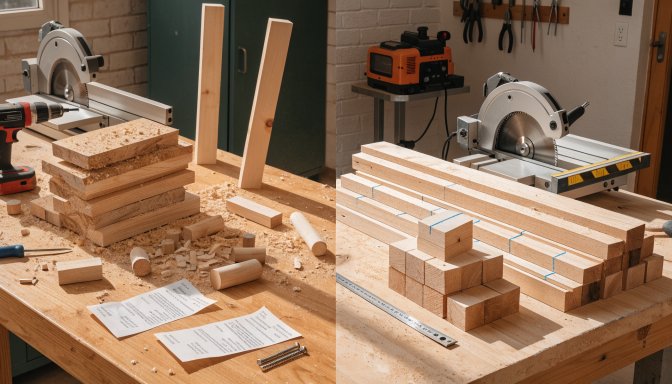
Not every woodworking mistake costs the same. Some just slow you down. Others hit your budget directly by wasting good lumber, forcing re-buys, ruining hardware placement, or turning a one-weekend build into a multi-trip project. For beginners, the expensive mistakes are usually planning mistakes in disguise.
Quick answer: The costliest woodworking mistakes for beginners are buying lumber without a cut plan, cutting critical parts wrong, ignoring actual stock thickness, using the wrong project for the available tools, and discovering missing hardware or material needs too late. Most of these costs can be reduced with better prep, not more expensive tools.
Where the money gets lost
- Buying too much wood because the cut list is incomplete
- Buying too little wood because defect allowance was ignored
- Ruining high-value boards on test cuts that should have happened on scrap
- Repeating wrong cuts because no sample part was verified first
- Restarting the project because the plan was not matched to the workspace or tools
High-cost mistake vs low-cost fix
| Costly mistake | Lower-cost fix |
|---|---|
| Batch cutting without verification | Cut and test one sample part first |
| Buying material from a rough estimate | Make a full cut list and board layout |
| Using premium boards for uncertain steps | Test setups on scrap or lower-cost stock |
| Improvising hardware decisions late | List hardware early with the materials plan |
Bottom line
If you want to protect your woodworking budget, focus first on the errors that compound. Good planning saves money twice: once when you buy smarter and again when you avoid rebuilding the same step.