
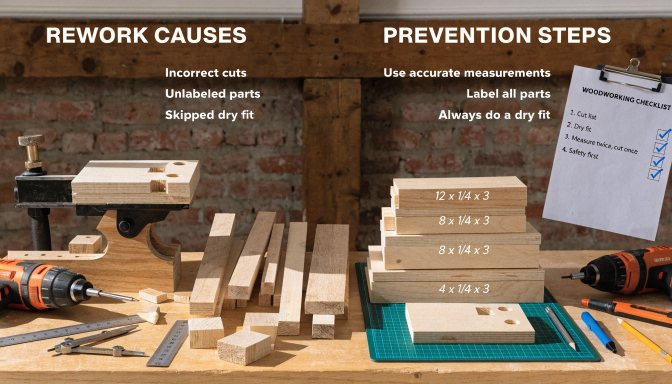
Rework usually feels like bad luck, but it almost always comes from something that was unclear earlier. A missed part label, a rushed batch cut, a skipped dry fit, or a weak build order can all create the kind of small problem that returns later as a much bigger interruption.
Quick answer: To avoid rework in woodworking projects, focus on early clarity. Read the plan fully, confirm the cut list, verify one sample part before repeating, label pieces as you go, and check fit before final assembly. Rework is usually a planning debt problem, not a speed problem.
Where rework begins
- Dimensions are copied once and never rechecked against the full design
- Parts that need to match are measured independently
- Materials are cut before the full order of operations is clear
- Assembly starts before problem areas are test-fitted
Small checks that prevent big fixes
| Check | What it prevents |
|---|---|
| One sample part before batch cutting | Repeating the same wrong dimension across multiple pieces |
| Part labels immediately after cutting | Confusion during fitting and assembly |
| Dry fit key sections | Discovering interference or misalignment too late |
| Build-order notes | Blocking later steps with earlier decisions |
Bottom line
The best way to reduce rework is to make uncertainty visible sooner. Small planning steps feel slower at first, but they remove the expensive kind of delay that shows up after parts are already cut and joined.