
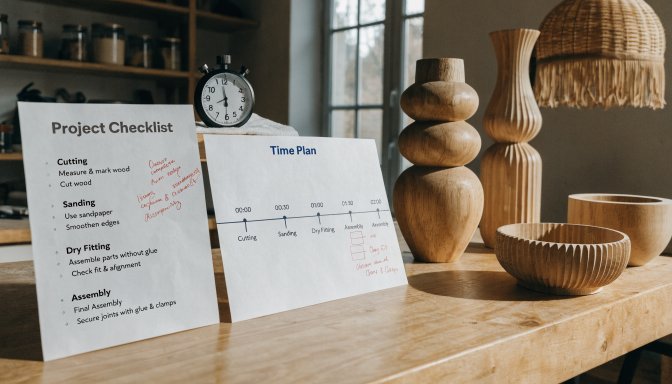
Time estimates go wrong when a project is judged by how simple it looks instead of how many decisions it contains. Cutting, sanding, drilling, staging materials, fixing small mistakes, and dry fitting all take time even when the finished project looks straightforward.
Quick answer: To estimate time for woodworking projects more accurately, break the build into stages, include setup and correction time, and assume that first-time tasks take longer than repeat tasks. Good estimates are built from process, not optimism.
Why beginner estimates are usually too short
They count cutting but not preparation
Reading the plan, labeling parts, checking material, and organizing the bench all consume time that rarely shows up in a beginner estimate.
They ignore transitions between stages
Switching blades, moving sheet goods, setting clamps, and cleaning the workspace between stages can easily add an hour or more to a build.
They assume no corrections
Most projects include at least one adjustment, whether that is a fit issue, a missed part label, or a small layout correction.
A better time-estimate framework
| Stage | What to include |
|---|---|
| Planning | Reading, part listing, material review, and cut-list prep |
| Material prep | Sorting stock, marking defects, staging boards or sheets |
| Cutting | Setup, test cuts, repeat cuts, and labeling parts |
| Prep and fitting | Sanding, drilling, dry fitting, and small corrections |
| Assembly | Clamp setup, glue, screws, square checks, and cleanup |
Bottom line
Time estimates improve when you stop asking, “How long should this take?” and start asking, “What steps actually happen?” That shift makes weekend builds more realistic and reduces rushed mistakes late in the project.