
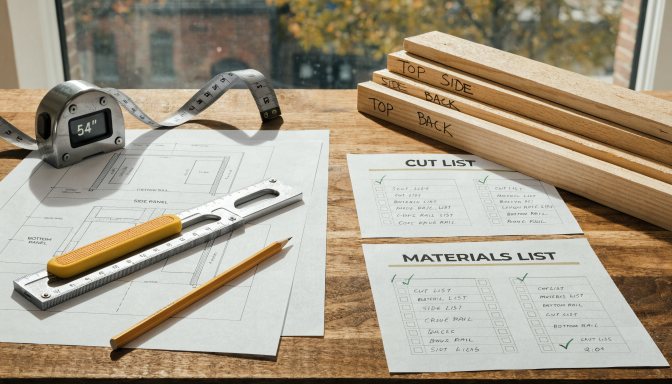
A planning checklist is useful because it turns vague preparation into a repeatable system. Most woodworking problems do not start with the saw. They start when a builder assumes the project is ready before the materials, cut list, part labels, or build sequence have been checked in full.
Quick answer: A good woodworking project planning checklist should confirm five things before the build starts: the plan is fully understood, the materials match the design, the cut list is complete, the build order is clear, and the project fits your tools, time, and workspace.
The core planning checklist
1. Read the full plan
Do not read just the first page or the obvious dimensions. Review the whole plan, including notes, joinery, hardware, and final assembly details.
2. Confirm the project parts
Make sure every visible part in the drawing appears somewhere in your notes, your cut list, or your part labels.
3. Verify actual material sizes
Nominal sizes and real sizes are not the same. If you skip this check, your joinery and final measurements can drift immediately.
4. Build the cut list and materials list
The materials list tells you what to buy. The cut list tells you what the project becomes. Both should be clear before cutting starts.
5. Sequence the build
Decide what must be cut first, what parts need to match, what can wait until after test fitting, and what order makes assembly easiest.
Simple planning checklist table
| Checklist item | Why it matters |
|---|---|
| Full plan review | Catches missing assumptions early. |
| Material verification | Prevents thickness and yield errors. |
| Cut list completion | Reduces waste and confusion during the build. |
| Build-order notes | Stops avoidable assembly problems later. |
| Tool and space check | Keeps the project realistic for your shop. |
Bottom line
A planning checklist is one of the easiest ways to build smarter without adding cost. The clearer your prep becomes, the less often the project surprises you in the middle.