
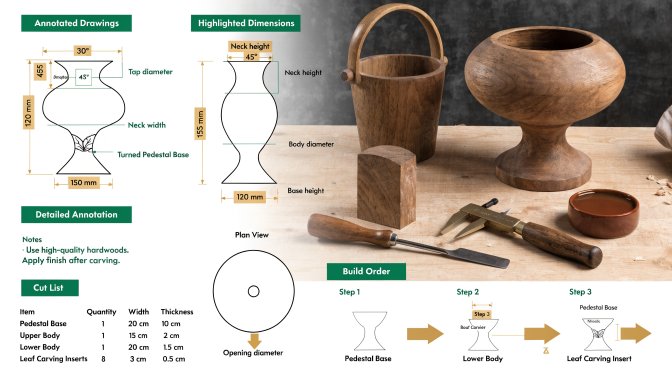
Reading woodworking plans well is not the same as looking at the pictures and collecting the dimensions. A plan only becomes useful when you understand how the parts relate, what the sequence depends on, and which details are easy to miss if you rush into cutting.
Quick answer: To read woodworking plans before building, start with the full overview, then study part names, final dimensions, material assumptions, joinery, hardware, and build sequence. The goal is to understand the system behind the project, not just the next cut.
What to read first
Start with the whole project view
Look at the finished project dimensions and major assemblies first. This gives you context before you try to interpret any single part.
Find the part relationships
Identify which pieces connect directly, which parts must match, and which dimensions control the rest of the design.
Look for hidden assumptions
Many plans assume material thickness, square stock, or certain tool capabilities without saying it clearly. Those assumptions matter before you buy wood or set up cuts.
Questions to ask while reading
- Do the part names in the drawings match the parts in the cut list?
- Are all dimensions clear, or are some implied?
- What parts need to be identical?
- What steps will be hard to fix later if done in the wrong order?
- Does the project depend on material thickness or hardware spacing?
A better plan-reading workflow
| Reading step | Purpose |
|---|---|
| Overview pass | Understand the full project before the details. |
| Part pass | Track every piece and where it fits. |
| Materials pass | Check stock sizes and assumptions. |
| Sequence pass | See how the build should flow in practice. |
Bottom line
If you read a plan only for the next number, you will miss the project logic. Read for structure first, then for dimensions. That is what makes the build feel clearer from the start.