
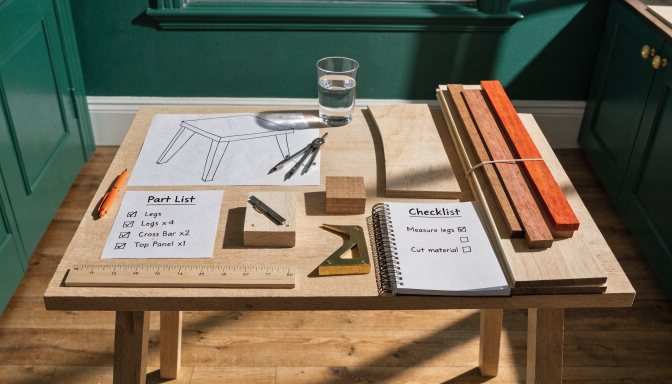
Project planning for beginners should not feel like writing a production manual. It only needs to answer the questions that usually create rework: what the project is, what parts it needs, what materials it uses, what order makes sense, and whether the build fits the shop you actually have.
Quick answer: Beginner project planning works best when you break the build into five parts: project fit, part list, material plan, cut sequence, and assembly order. This keeps the work simple while still preventing the most common mistakes.
The beginner-friendly planning system
Choose a project that fits your setup
Pick something that matches your tools, space, and confidence level. Good planning starts by avoiding projects that ask more from the shop than the shop can reasonably give.
List every part
You do not need a complicated spreadsheet. A clear written list of all parts, sizes, and quantities is enough to reduce confusion later.
Plan the materials simply
Think in boards, panels, and waste allowance. If the material plan feels vague, the project is not ready yet.
Decide the sequence
Know what parts should be cut first, what should wait until after test fitting, and what groups of parts need to match exactly.
What beginners tend to overcomplicate
| Overcomplicated habit | Simpler approach |
|---|---|
| Trying to plan every tiny detail at once | Start with parts, materials, and sequence first |
| Using advanced project software too early | Use a clear notebook or simple table if that is faster |
| Choosing projects for ambition alone | Choose projects that teach skills without overwhelming the shop |
| Guessing about materials | Write a materials list before shopping |
Bottom line
Beginner planning is not about complexity. It is about clarity. The more clearly you can describe the project to yourself before you start, the easier it becomes to build it well.