
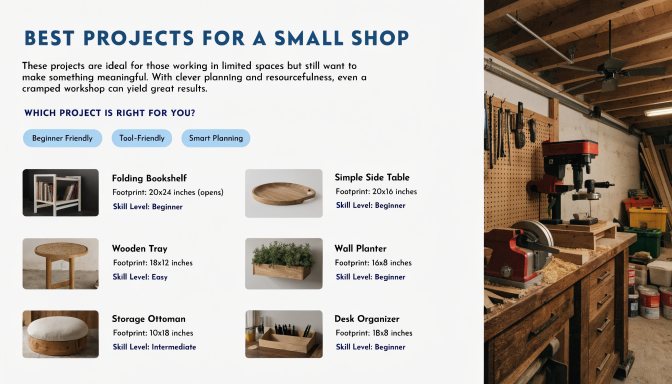
Choosing the right project matters more in a small shop because a bad match creates problems at every stage. A project can be beginner-friendly on paper and still be a poor choice if it needs more assembly room, longer stock handling, or more dedicated bench space than your setup allows.
Quick answer: Use a small shop project selection guide to judge projects by footprint, part count, material handling, and stopping points between sessions. The best projects fit both your skill level and your actual workspace.
Questions to ask before choosing a project
- Can the project fit on your main bench during key stages?
- Will raw stock or large panels block the room?
- Can the project be built in sections if time is limited?
- Does the finished piece solve a real storage or home-use problem?
Project selection table
| Project type | Small-shop suitability |
|---|---|
| Wall organizer | Excellent because footprint stays small |
| Side table | Strong choice for furniture practice |
| Storage bench | Good if dimensions stay moderate |
| Large dining table | Risky in tight spaces without advanced staging |
Best rule of thumb
If the project only works when the shop is perfectly clear and the whole day is free, it may not be the best next build. Small shops usually reward practical, modular, pause-friendly projects first.
Bottom line
A small shop project selection guide is really a decision filter. It helps you choose builds you can finish cleanly instead of builds that overwhelm the space halfway through.