
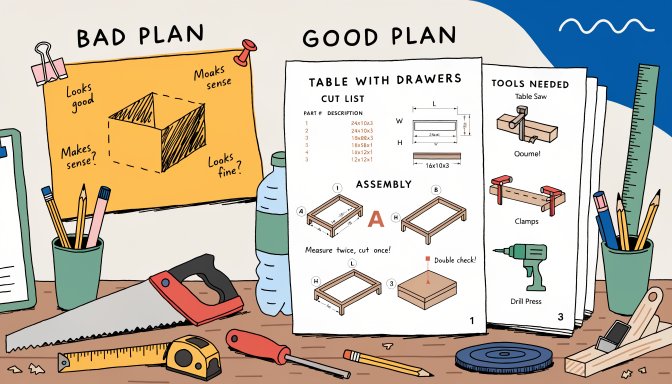
The best woodworking plans do not leave you wondering what happens next. They reduce guesswork by showing the full path: what parts you need, how they relate, what order they go together in, and where common mistakes are likely to happen. That clarity matters even more for beginners.
Quick answer: The best woodworking plans to avoid guesswork include complete materials and cut lists, readable diagrams, realistic dimensions, and step-by-step instructions that make part relationships and assembly order easy to understand.
Features that reduce guesswork
- Complete materials list before the build starts
- Cut list that matches the diagrams
- Clear build sequence with obvious transition points
- Dimensions that stay consistent across all views
What vague plans usually miss
Weak plans often leave out crucial dimensions, treat assembly like an afterthought, or assume the builder can infer missing details from one sketch. That might be manageable for experts, but it creates costly confusion for most hobbyists.
| Strong plan feature | Why it matters |
|---|---|
| Consistent diagrams | Prevents interpretation errors |
| Step-by-step flow | Supports confident progress |
| Complete part list | Improves buying and cutting accuracy |
| Practical detail level | Keeps builders from improvising too early |
Bottom line
The best woodworking plans to avoid guesswork are the ones that answer the important questions before the saw turns on. Better information leads to calmer, cleaner builds.